Orcastration
Docker Swarm GUI Tool: Visualize your Docker Swarm with powerful metrics.
Introducing Docker Swarm
Docker Swarm is a powerful container orchestration tool that simplifies the management and deployment of multiple Docker containers as a cohesive service. Its key strength lies in its ability to efficiently orchestrate containerized applications across a distributed system.
The Problem: Managing and Visualizing Docker Swarm
The task of managing and visualizing Docker Swarm nodes, container metrics, and health statistics can be highly challenging. As the scale of deployment increases, it becomes increasingly complex to keep track of numerous nodes, tasks, and containers that need to be managed effectively.
The command-line interface provided by Docker Swarm can be tedious and error-prone, particularly when dealing with large-scale deployments. Furthermore, gaining insights into the health and performance of Swarm nodes and containers can be a difficult task without appropriate visualization tools. While solutions like Prometheus with Grafana exist in the market, they often require a steep learning curve and can consume valuable time.
Introducing Orcastration: A Solution for Docker Swarm Visualization
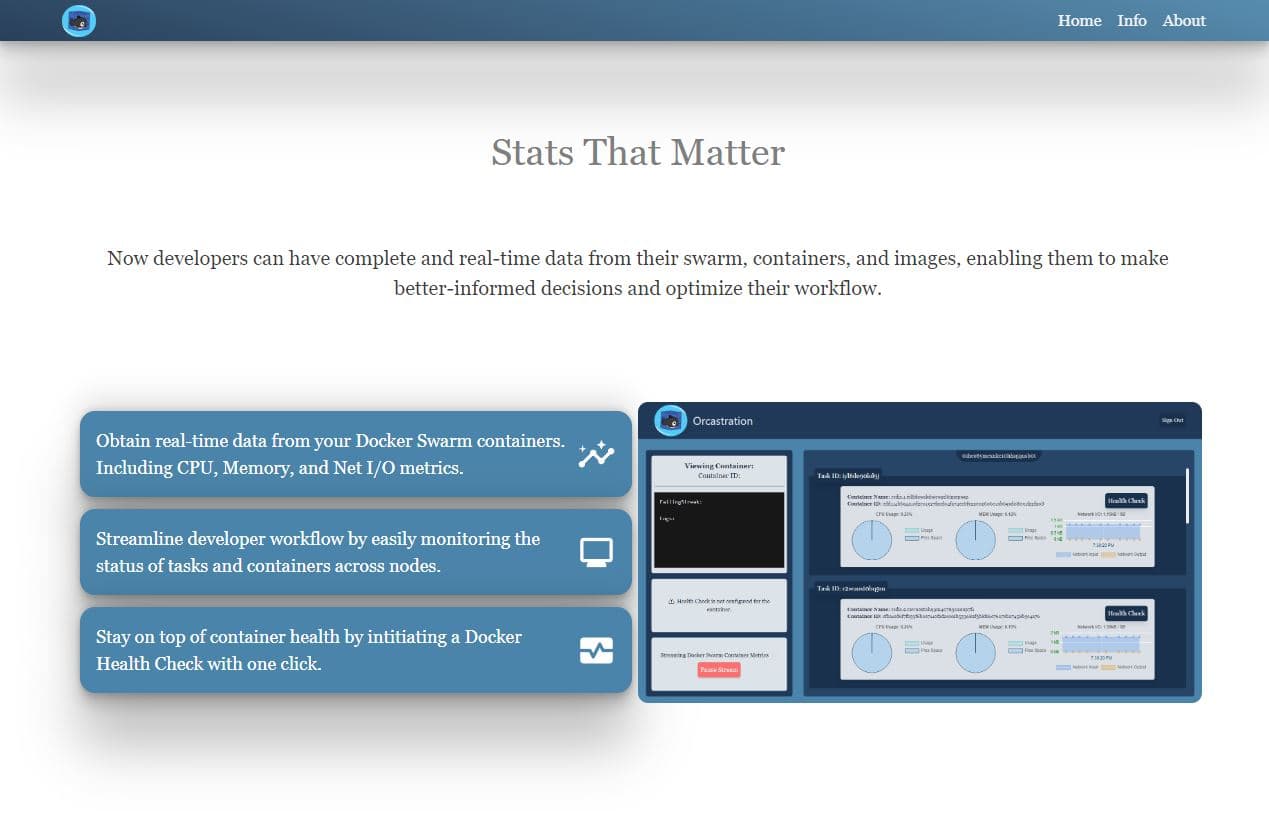
Orcastration, a Docker Swarm visualization tool, addresses these challenges by providing users with real-time visibility into their containers within Docker Swarm. It also offers metric information and health status for the containers. By monitoring the health and status of containers, users can proactively identify and address potential issues before they lead to disruptions or downtime.
Unlike traditional methods that involve executing numerous Docker terminal commands to view container metrics, Orcastration offers a simplified approach. This user-friendly tool allows you to easily visualize the nodes in your Docker Swarm cluster, along with metrics and health status for your running tasks and containers. With Orcastration, identifying and resolving issues becomes a seamless process, enabling smoother operations and increased productivity. Read more about the product here at Orcastration.
My Contributions to Orcastration
I played a significant role in the development of Orcastration, contributing across the full stack and driving the release of the beta version under OSLabs. Building this product from the ground up required wearing multiple hats and involved various tasks.
To achieve real-time streaming of numerous nodes, I developed an optimized backend process. This modular backend process effectively parsed Docker Swarm node and container data from the Docker daemon, reformatted it, and stored it in our database. To ensure robust functionality and reduced server latency, I leveraged Node.js and Express, employing middleware design, testing, and error-handling patterns. Additionally, I set up multiple Docker containers and Docker Swarm instances, implementing health checks to simulate container and swarm environments for testing and development. For API development, I utilized Postman, while Jest and Cypress facilitated testing to enhance team collaboration, scalability, and quality assurance.
On the frontend, I designed a highly performant and responsive user interface using Tailwind CSS. This approach maintained a consistent and efficient codebase by leveraging predefined classes. To facilitate real-time data streaming, I implemented the EventSource API, which enabled server-sent event protocols and dispatched container metrics and health data to the client. By following the observable design pattern, actionable alerts were created, empowering development teams to manage technical debt and make data-driven decisions. I also created custom Hooks to stream real-time information and utilized Chart.js to synthesize visual charts with live updates of Docker container metrics and health status. These enhancements significantly improved the user experience, allowing developers using Orcastration to monitor their Docker Swarm clusters in real-time, including dynamic container metrics such as CPU usage, network I/O, and health information.
Challenges Overcome
The development of Orcastration presented several challenges that I successfully addressed:
- Understanding Docker and Docker Swarm: Extensive research and documentation review were conducted to gain a deep understanding of Docker, Docker Swarm, and related concepts.
- Developing Data Parsing Algorithms: Carefully designed algorithms were implemented to parse data from the Docker daemon and map it to visualization charts. Choosing between the Docker API and the Docker Command Line Interface (CLI) involved considering security concerns and evaluating the pros and cons of each approach.
- Modularizing the Codebase: The codebase was organized into modular and reusable components, with special attention given to creating helper functions and defining the appropriate data structure for seamless integration with the Docker CLI.
- Meeting Deadlines and Refactoring: Balancing time constraints and sprint deadlines, the team initially focused on delivering a minimum viable product (MVP). Subsequent efforts were dedicated to refactoring the codebase to improve scalability and performance.
- Real-time Streaming of Docker Swarm Data: Implementing real-time streaming of Docker Swarm-specific data presented a unique challenge. The optimal solution was achieved by leveraging
Server-Sent Events(SSE), a stateless protocol that continuously streams data until closed. Evaluating alternative approaches such as long polling and bidirectional communication with websockets informed the decision-making process.
To learn more about the product, I invite you to read our Medium article. Orcastration represents a significant step forward in visualizing and managing Docker Swarm clusters, empowering developers to streamline their operations and make informed decisions based on real-time data.